The Rural Health Transformation Program: Local Calibration Is Essential

By Josh Gray and Nigel Harriman

The Rural Health Transformation Project is an unprecedented federal initiative that commits $50 billion over five years to reshape healthcare delivery in rural America. Participants are expected to pursue transformative technologies, new care delivery models, workforce innovation, and digitally enabled approaches to care. The scale and scope of this initiative is unprecedented The legislation includes an incentive structure around innovation and accountability. States must submit detailed transformation plans describing how they will improve rural health access, outcomes, workforce capacity, and care delivery. A significant portion of funding is tied to strategy, execution, reporting, and demonstrating progress – rewarding organizations and partnerships that can implement credible, data-driven approaches to improving outcomes and penalizing those who can’t.

In other words, organizations and providers that want to earn and sustain funding will need to show measurable progress against predetermined outcomes. Early in the program, some of these may be process measures, including improving telehealth access or developing workforce trainings and care coordination programs. Over time, expectations will shift toward showing measurable improvement in outcomes, such as avoidable hospitalizations, readmissions, chronic disease burden, total cost of care, or mortality.

Moving clinical outcomes will be a significant challenge.  Health outcomes are driven in part by socioeconomics, which vary a great deal across counties and are extremely difficult to influence.  Moreover, the health profiles of the 2200 rural counties in the United States vary dramatically.  What works in one county may fail in another: to move the dial on outcomes. Providers and public health professionals will need to be surgically focused.

This is illustrated in the graph below, which depicts mortality rates for the roughly 7 million Medicare fee-for-service beneficiaries residing in rural counties in 2025.
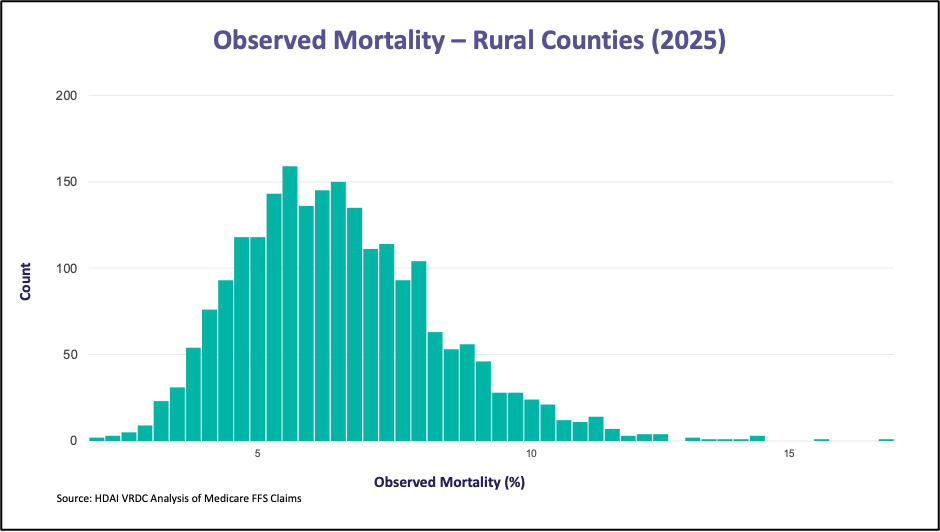
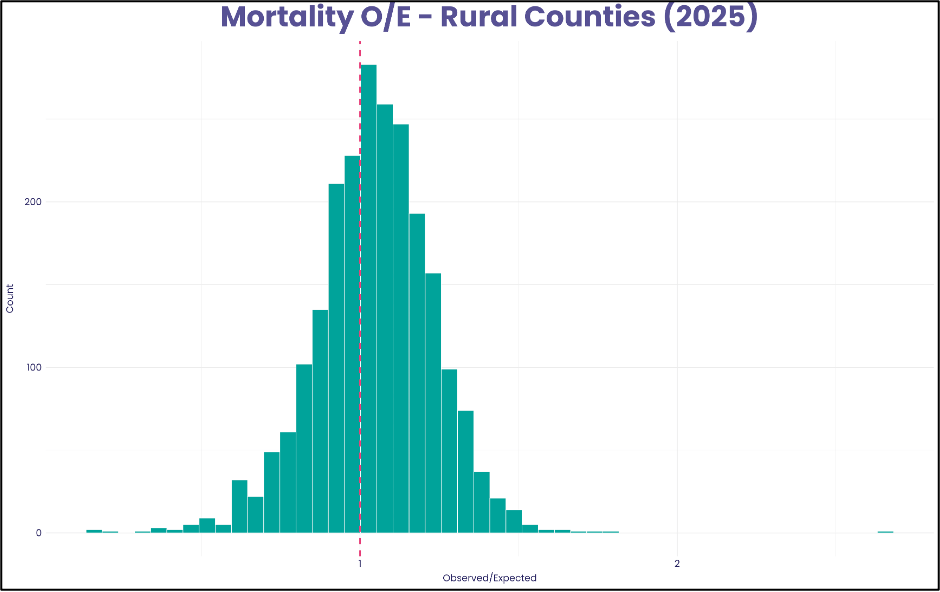
The dispersion is notable: 457 (21%) of counties have mortality rates 25% below the national average, while 403 (18%) have mortality rates 25% above the national average. Importantly, these are unadjusted rates. However, controlling for demographics and medical history explains only part of the observed differences. As shown below, substantial differences remain even after adjustments based on health status and medical conditions, which suggests that local infrastructure, provider access, care delivery models, community conditions, and health behaviors continue to shape outcomes.
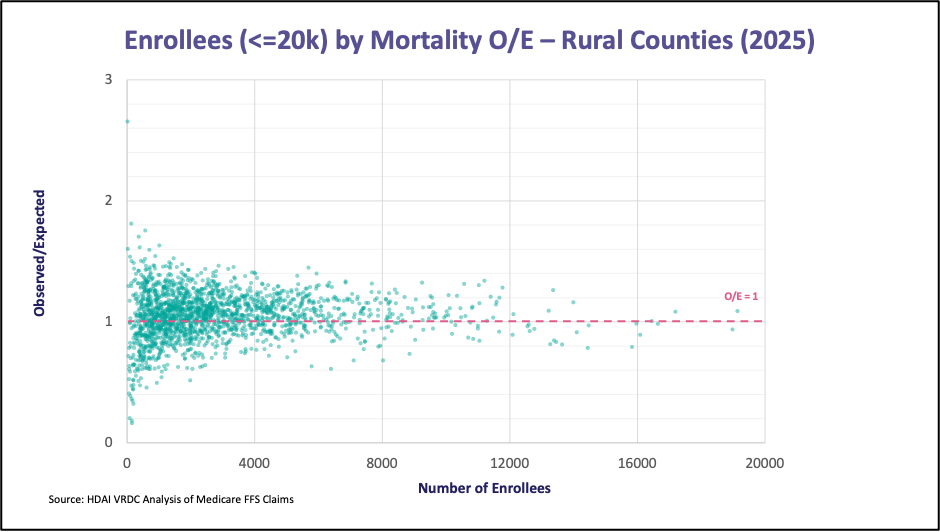
Small rural counties present even greater challenges. As shown below, 23% of rural counties have both higher observed to expected mortality (OE>1) and less than 2,500 people in them. Small rural areas are often further disadvantaged by limited provider capacity, fragile healthcare infrastructure, and insufficient resources to support broad-based transformation efforts.
These observations raise pressing strategic questions for providers and public health leaders. A one-size-fits-all approach will not work – rural counties vary enormously in their demographics, resources, and needs, and will require different types of interventions at and budgets. In many counties, dispersed populations and limited infrastructure mean that remote care technologies will be essential. Interventions that aren’t data-backed and carefully designed to respond to local realities will almost certainly fall short.

If you work with a provider organization or public health entity and are curious about recent outcomes, including mortality, readmissions, ED utilization, or other measures, in your county or counties, please reach out. We would be happy to review relevant data with you.

Josh Gray, VP of Analytic Services, HDAI ([email protected])

Nigel Harriman, Sr. Data Analyst, HDAI ([email protected])


SHARE

Facebook
Twitter
LinkedIn

Your privacy matters

We believe that an individual’s meaningful control over their own data is as valuable as the data itself. That’s why we are committed to protecting privacy at every turn.
We always:
  • Provide transparency about the information we collect and why we collect it
  • Comply with all applicable privacy rules and regulations
  • Delete personal data from our servers if an individual opts out
We never:
  • Sell data to third parties
  • Share data with third parties besides the primary, explicitly authorized institution
  • Collect data besides what is disclosed
  • Keep personal data for individuals who have opted out

We speak legalese only when we have to, but we do our best to keep it human. Provided below are the full versions of our Privacy Policy and Terms of Service. If you have any questions, don’t hesitate to contact us for clarification.

Scott Cullen MD
Chief Medical Officer

Dr. Scott Cullen has more than two decades of experience advancing clinical innovation, digital transformation, and value-based care. He has held senior leadership roles across health systems and consulting firms where he guided organizations in adopting data-driven, patient-centered care models. As Chief Medical Officer at HDAI, Dr. Cullen helps shape AI-enabled solutions that improve clinical outcomes. His work is grounded in his early career as a practicing physician, a frontline perspective that continues to drive his passion for building technology that empowers clinicians and humanizes healthcare.

Bill Floyd
VP Sales

Bill brings a lifetime of curiosity, discipline, and humor to HDAI. Married for more than 40 years, he is a proud father of three and grandfather to one and shares his home with two dogs—one a rescue—while firmly maintaining a no-cats policy.

An oyster farmer by trade (despite not being an oyster eater or much of a shucker), Bill’s path reflects an appreciation for hard work. He is passionate about business, lifelong improvement, and thoughtful problem-solving, often delivered with a healthy dose of sarcasm.

Raphael Cohen
VP AI and Engineering

With expertise in machine learning, cloud computing, and healthcare, Raphael translates complex technical challenges into practical healthcare solutions. He’s pioneered ML platforms to drive innovations in radiology, pathology, and anesthesia while simultaneously improving operational efficiency and scale. Outside of work, he’s an avid cyclist who regularly participates in the Pan-Mass Challenge, enjoys hiking the White Mountains, and is often found playing guitar. He received a BS in Computer Science and Applied Mathematics from Brandeis University.

Bob Scott
VP Security, Compliance, and IT Operations

Bob has 20 years experience enhancing IT systems and security programs in regulated companies.  He has worked with global enterprises down to 10-person start-ups.  He currently holds both CISSP and CCSP certificates from ISC2.  Bob’s professional passion is negotiating the sweet-spot between Security, Efficiency and Company Resources.  Personally, Bob is a land-locked boatsman who laments every day away from the water and an avid table-top gamer.  He received a BS in Microbiology from Cornell.

Summer Kramer
VP Clinical Programs

Summer is a clinical pharmacist with over 15 years of experience in the healthcare industry, including hospitals, payors, and start-ups. Summer has focused her career on clinical program development and healthcare analytics with a constant drive to improve patient outcomes.

Residing in the pacific northwest, Summer enjoys hiking, camping, sailing, and traveling. She received her PharmD from the University of New Mexico, College of Pharmacy.  

Kevin Sampson
VP Finance

Kevin is a CPA with 25 years of executive and managerial experience in accounting, corporate finance, and operations in a variety of industries including medical device, biotechnology, and pharmaceuticals.

By listening and connecting with people, Kevin understands that accurate timely information is vital for everyone in the healthcare system. He received a BS in Accounting and an MBA in Finance and Entrepreneurial Studies from Babson College.

Paul Manberg
VP Clinical and Regulatory Affairs

Paul is an innovative, pragmatic leader with over 40 years’ experience in the medical device and pharmaceutical industries. He has directed clinical trial programs and regulatory activities supporting the successful market introduction of numerous impactful products. He spends his leisure time on the Outer Banks of North Carolina, body surfing and fishing. He received a PhD in pharmacology from The University of North Carolina School of Medicine.

Scott Greenwald
Chief Scientist

With over 25 years’ experience in healthcare research and innovation, Scott is an unprecedented leader in his field, focusing on improved care for everyone. He is an author of over 10 US Patents and over 100 peer-reviewed abstracts and manuscripts. While he’s not immersed in research, you’ll find him playing a mean round of mini golf. He received a PhD in Medical Engineering from the Harvard-MIT Division of Health Sciences and Technology (HST).

Josh Gray VP Analytic Services

Josh has 30 years’ experience in healthcare, including The Advisory Board Company, athenahealth, and Boston Consulting Group. Across his career, he has used a wide range of conventional and unconventional data sources to understand and teach the keys to top performance among the nation’s most innovative health systems and physician groups. Josh enjoys music, hiking, traveling, and watching his daughter take part in synchronized skating competitions. He received an MBA from The Wharton School at the University of Pennsylvania and an undergraduate degree from Brown University.

Carola Endicott
VP Customer Engagement, Marketing

Carola has 30 years’ experience in healthcare, including HMOs, hospitals, and start-ups. Her knowledge and optimistic outlook in operations and leadership, and her passion for making healthcare workers’ lives easier is what drives her devotion to customer engagement. She received an EdM from Harvard University Graduate School of Education.

David Clain Chief Product Officer

David has vast experience with healthcare customers from his time at The Advisory Board Company and athenahealth. His expertise and passion for statistics, strategy, and innovative analytic insights is unrivaled, as is his devotion to the Duke Blue Devils. Looking for that “aha moment” of positive change is what drives him. He received a BA from Duke University.

Margie Ahearn
VP HR

Margie has 25 years of experience in HR leadership. An avid boater, Margie has received numerous awards for excellence in HR and is always looking for challenges to grow professionally and personally. She graduated with an MBA from Southern New Hampshire University.

Nassib Chamoun
Founder and CEO

Nassib is a data scientist, lover of logistical regression and a serial entrepreneur. Previously, he was Founder and CEO of Aspect Medical Systems, a Nasdaq traded company now owned by Medtronic. Outside of work, he enjoys hosting and honing his cooking skills – specializing in Middle Eastern and outdoor feasts. He received an MS from Boston University.

Phil Devlin
COO

Phil has 30 years of experience in executive leadership. Along his journey he’s made effective and profound change in science. Little known facts about him — he loves traveling with his family, he was in the MD Engineering program at Harvard Medical School and owns 15 patents. He received an MS from Northeastern University.

What guides our culture

1

We are driven to make a profound impact on US healthcare

2

We operate in the best interests of patients and those who serve them

3

We understand and protect patient privacy and health information security

4

We use data science to enhance, but never replace clinical expertise and judgment

5

We are committed to continuous learning and improvement

6

We bring rigor, discipline, and reliability to our work

7

We start with kindness, assuming good intent in others

8

We are committed to building a diverse, inclusive team where all employees feel welcomed and appreciated

9

We are committed to the well-being of our employees and their families

Our vision

We envision a healthcare system where decisions are routinely informed by personalized care profiles and predictive analytics, which will improve the health of individuals and populations.

Our mission

Deploy a versatile analytic platform that creates a shared understanding of quantified health risks to inform actions with the greatest potential to benefit patients.

Who we are

We collaborate with leading health systems and integrated delivery networks, value-based care and accountable care organizations, physician groups, and commercial payers to improve care delivery and population health while reducing costs and making efficient use of scarce clinical resources.

Phil Devlin
COO

Phil has 30 years of experience in executive leadership. Along his journey he’s made effective and profound change in science. Little known facts about him — he loves traveling with his family, he was in the MD Engineering program at Harvard Medical School and owns 15 patents. He received an MS from Northeastern University.