
Flip the work upside down: Reallocating human and artificial intelligence for diagnostic discovery
By David Clain, Chief Product Officer
I spend a lot of my time talking to revenue cycle, CDI, and coding executives about our vision for predictive diagnostic discovery — using a combination of predictive models, LLM-generated insights, and human-curated guidelines to identify diagnoses from a patient’s clinical encounters.
I wrote last week about how we use deep reasoning with frontier AI models to generate some of our insights. But I didn’t write about the core premise that underpins many of my conversations with hospital leaders: that we should flip the work upside-down.
Consider the work of typical coders and CDI specialists. Their work may be supported by rudimentary rules or natural-language processing to flag key terms and certain suspect lab values. But at its core, their work at many institutions is fundamentally analog: review the patient’s history, read every clinical note, assess labs and vitals, and produce a set of ICD-10 codes that represent all you’ve learned about the patient.
In a typical health system, that process can take a CDI specialist 30 minutes for a first review. This work is clinically complex, requiring a great deal of judgment and experience. But it is also tedious. A CDI expert has to carefully review every part of the patient record to produce a handful of codes.
That process looks like the typical approach you see below — notes in, transformed by CDI expertise, and ICD-10 codes and queries to physicians out.
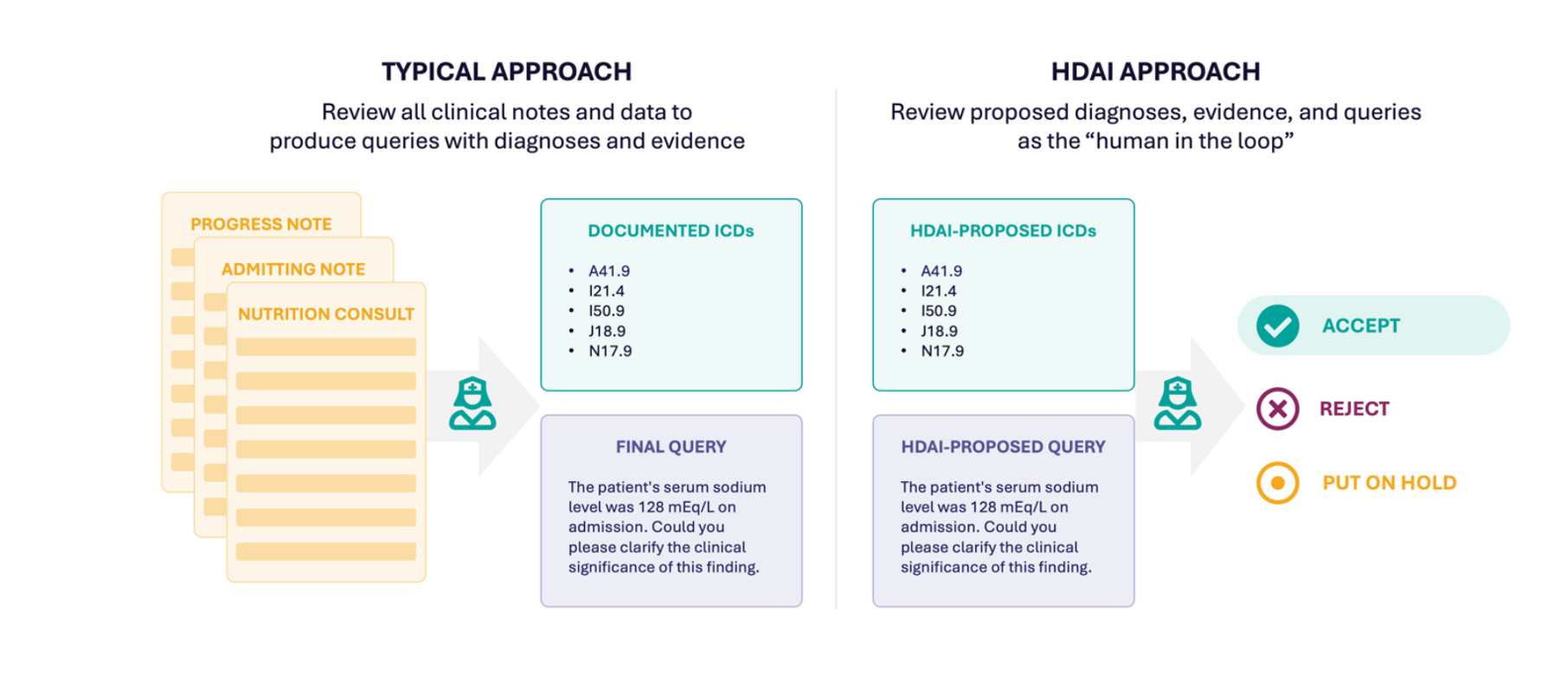
The HDAI approach above is what we’ve implemented with our health system partners. We are not eliminating CDI specialists and coders — their clinical judgment remains central to the diagnostic discovery process. Instead, we are building what we think is the right allocation of work to CDI specialists and coders, on the one hand, and to artificial intelligence on the other. Computers do the work they are uniquely positioned for: scanning troves of raw data, applying thousands of clinical and coding rules, and presenting and prioritizing the curated information. They do this without tiring, getting distracted, or needing breaks.
Our CDI and coding colleagues do what humans still do best. They review the assembled insights, and they apply their experience and judgment to decide what to query for and what to code. They know their institutions, their patients, and their colleagues. We use AI to help them deploy that knowledge as effectively as possible by reviewing relevant insights, not looking for needles in haystacks.
My colleagues and I are excited to share more results over the coming months.
If you’re interested in learning more about our predictive diagnostic discovery work or to partner with HDAI to deploy this technology at your health system, please contact info@hda-institute.com.
Share this