
HealthVision brings predictive analytics and generative AI into the EHR, giving clinical and operational leaders the intelligence to identify risk earlier, reduce preventable readmissions and avoidable cost, allocate resources where impact is greatest, and measure performance against peers—without adding staff, disrupting workflows, or waiting months to go live.
Request a DemoProven Outcomes for Our Partners
The Intelligence Gap That’s Costing You Outcomes, Revenue, and Time
Clinicians spend an average of 6 hours per day navigating EHR data that was never designed to surface what matters most:
- Which patients are at highest risk
- Which diagnoses and documentation gaps are leaving revenue on the table
- Where interventions will have the greatest impact
Single-solution AI tools address fragments of this problem. None connect predictive risk, clinical documentation support, and decision support in a single, embedded experience.
How HealthVision Closes the Gap
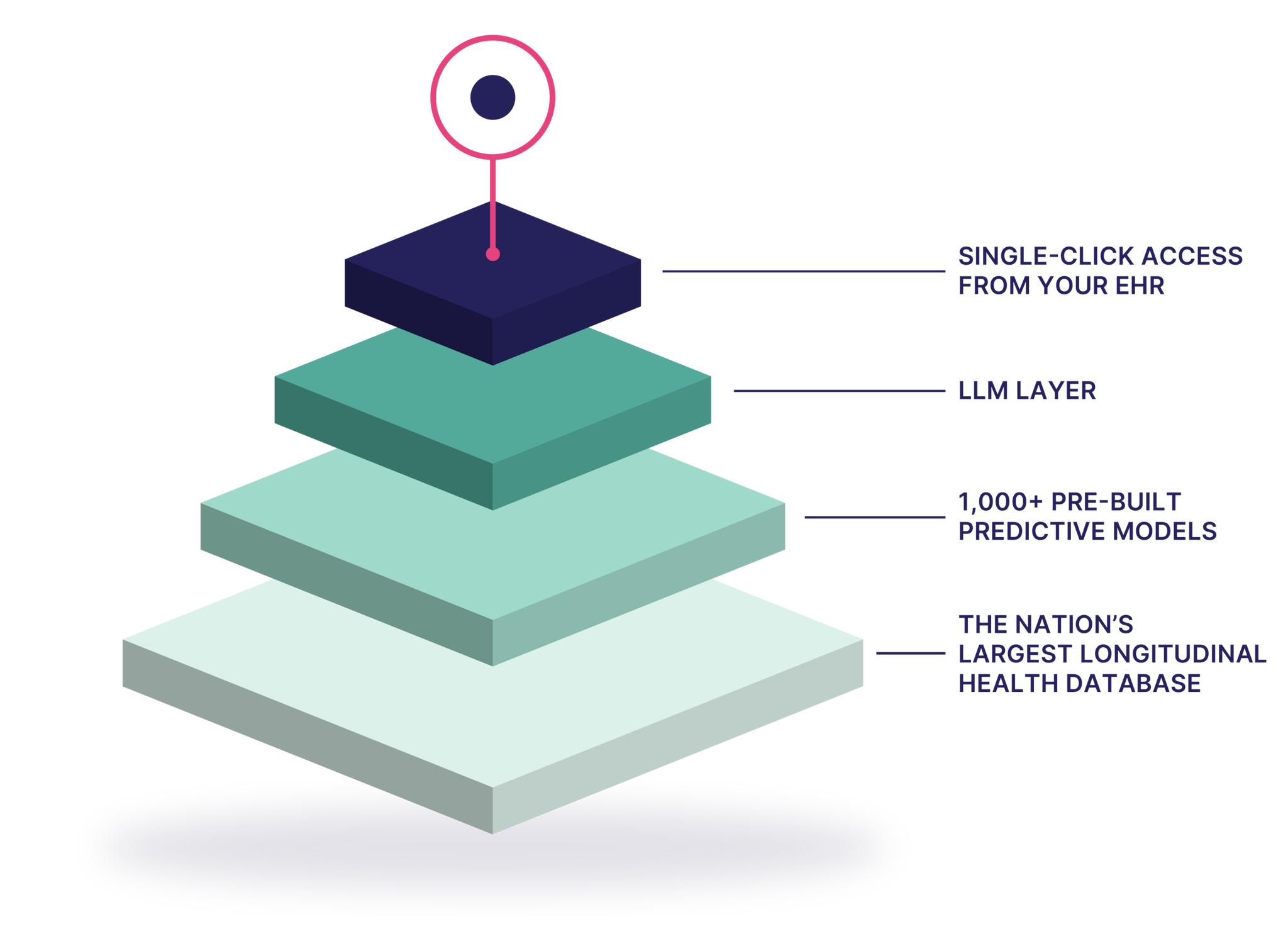
HealthVision is a modular, configurable, EHR-embedded enterprise solution that is inclusive of 1,000+ pre-built, peer-reviewed predictive models powered by the nation’s largest longitudinal health database: 140M+ patients, 500B+ encounters, and 25+ years of Medicare claims data. And, featuring the most advanced LLMs in a secure, low-latency, web architecture. Clinicians and other users access it directly from the patient chart with a single click.
Platform Capabilities
Three Intelligent Capabilities. One Integrated Foundation.
Individual Level
Intelligent Health Record
For clinicians at the point of care, this risk-focused patient profile synthesizes history, active risks, and predicted trajectories directly in the EHR.
Most importantly for busy providers—every patient view is tailored to the encounter context—goals of care, disease management, discharge planning—updated in real time. Forward-looking risk summaries replace hours of digging through historical records, so clinicians see what matters for this patient, right now, in seconds. Every data point is traced to its source.
Individual + Care Team
Intelligent Triage
Real-time risk scores across readmission, mortality, complications, length of stay, and hundreds more clinical endpoints, matched to the care workflows that improve outcomes. For schedulers, case managers, clinic managers, clinical documentation specialists, and others, purpose-built rosters surface the patients who need attention now—for heart failure, readmission prevention, palliative care, or diagnoses identification—ranked by predicted risk or likelihood to match up with existing pathways and resources.
Predictions recalculate continuously as new clinical data flows in. For ACOs, rosters are generated from weekly CMS claims data to prioritize patients with specific complex needs for outreach across your attributed population.
Real-time risk scores support organizational initiatives to lower readmission, mortality, complications rate and to capture the full picture of the patient’s conditions across hundreds of clinical endpoints.
Predictions spanning the full clinical and financial continuum
Organizational Level
Intelligent Analytics
For analytics teams, HDAI has built a comprehensive system of national benchmarks powered by HDAI’s unique digital twinning methodology that enables true apples-to-apples comparisons: not just who treated the most patients, but who achieved the best outcomes for patients like yours, matched at the risk and demographics level, patient by patient.
Many clients value the modeling of future USNWR, CMS, and other ranking agency results, well ahead of the published results. Others use digital twinning to evaluate network design, provider performance variation, and referral optimization across post-acute pathways. For ACOs, this extends to quarterly Medicare claims benchmarking across your provider, SNF, and home health networks.
Why HealthVision and Why Now
| Traditional Approach | Impact | ||
|---|---|---|---|
| Configurability | Solutions that are either too small or too large to adapt to new use cases | Adaptable to the emerging needs, new workflows | No waiting for long engineering cycles, immediate response |
| Generative AI | Out of the box LLMs not designed for healthcare | Built with clinical oversight for relevancy and expediency | $14M+ avg revenue per system |
| Model Robustness | Models built on small, specific datasets with inadequate accuracy | 140M+ patients, 500B+ encounters, 25 years of longitudinal CMS data | Highly performant models out of the box |
| Transparency | Black-box scores with limited clinical context | Every prediction is explainable and traced to its source | Trust precedes action and action drives improvement |
| Timing | Lagged findings make it harder to prevent bad outcomes | Predictive models identify risk before the adverse event | Identify missed diagnoses, avoid CMS readmission penalty |
| Access | Separate system, separate login, separate workflow | EHR-native; surfaces inside Epic and other EHR workflows | Adoption drives higher ROI |
| Deployment | Months of model training on your data | Pre-built, validated models deploy in 2–3 weeks on your existing infrastructure | Immediate ROI |
Configurability
Traditional
Solutions that are either too small or too large to adapt to new use cases
Adaptable to the emerging needs, new workflows
Impact
No waiting for long engineering cycles, immediate response
Generative AI
Traditional
Out of the box LLMs not designed for healthcare
Built with clinical oversight for relevancy and expediency
Impact
$14M+ avg revenue per system
Model Robustness
Traditional
Models built on small, specific datasets with inadequate accuracy
140M+ patients, 500B+ encounters, 25 years of longitudinal CMS data
Impact
Highly performant models out of the box
Transparency
Traditional
Black-box scores with limited clinical context
Every prediction is explainable and traced to its source
Impact
Trust precedes action and action drives improvement
Timing
Traditional
Lagged findings make it harder to prevent bad outcomes
Predictive models identify risk before the adverse event
Impact
Identify missed diagnoses, avoid CMS readmission penalty
Access
Traditional
Separate system, separate login, separate workflow
EHR-native; surfaces inside Epic and other EHR workflows
Impact
Adoption drives higher ROI
Deployment
Traditional
Months of model training on your data
Pre-built, validated models deploy in 2–3 weeks on your existing infrastructure
Impact
Immediate ROI
Solutions
Purpose-Built Solutions for Specific Clinical Challenges
Each solution is powered by the same predictive engine, tuned to the workflows, endpoints, and outcomes that matter in each setting.
Diagnostic Discovery
Predictive identification of ICD gaps and diagnostic omissions, ranked by revenue impact and clinical significance.
Learn MoreAcute Care Management
Real-time readmission risk scoring, discharge optimization, and predictive flagging of anticipated clinical need.
Learn MorePerioperative Optimization
Automated stratification for pre-procedure visits, patient-specific risk profiles quantifying complication probability, and resource planning across 150+ surgical case types.
Learn MorePopulation Health
Predictive risk stratification, HCC capture support, and population-level forecasting for ACOs and other value-based care organizations.
Learn MoreFind Your Starting Point
Our team will help you identify the highest-impact opportunity and build a roadmap for long-term value.