
For AI-driven revenue capture, you haven’t missed the boat yet
By David Clain, Chief Product and Strategy Officer, HDAI
Many of the hospital executives I speak with have a gnawing sense of discomfort—or sometimes even very deep anxiety—that they will be stragglers as AI reshapes our industry. Vendors naturally play to this fear, highlighting their transformative “AI native” technologies. In the revenue cycle space in particular, we have seen vendors promise dramatically better documentation and revenue capture for hospitals that adopt their solutions.
The good (and bad) news? The data shows no evidence that top-performing hospitals are pulling away on revenue capture—so the anxious executive isn’t behind just yet.
Benchmarking CMI across the country
My HDAI colleagues and I assess the case mix index (CMI) of every hospital in the country on an observed to expected (O/E) basis, measuring documented patient acuity against what we expect based on a cohort of risk-matched digital twins. A CMI O/E of 1 represents a hospital whose CMI matches exactly what its peers manage for an equivalent population.
If indeed the nation’s top hospitals were using advanced AI tools to pull away from the average, I would expect to see the top performers at the country’s largest hospitals—the ones that can afford the new AI tools—to do better on O/E CMI than smaller hospitals, which would likely be stuck with manpower or previous-generation tools.
The reality is: they haven’t done so.
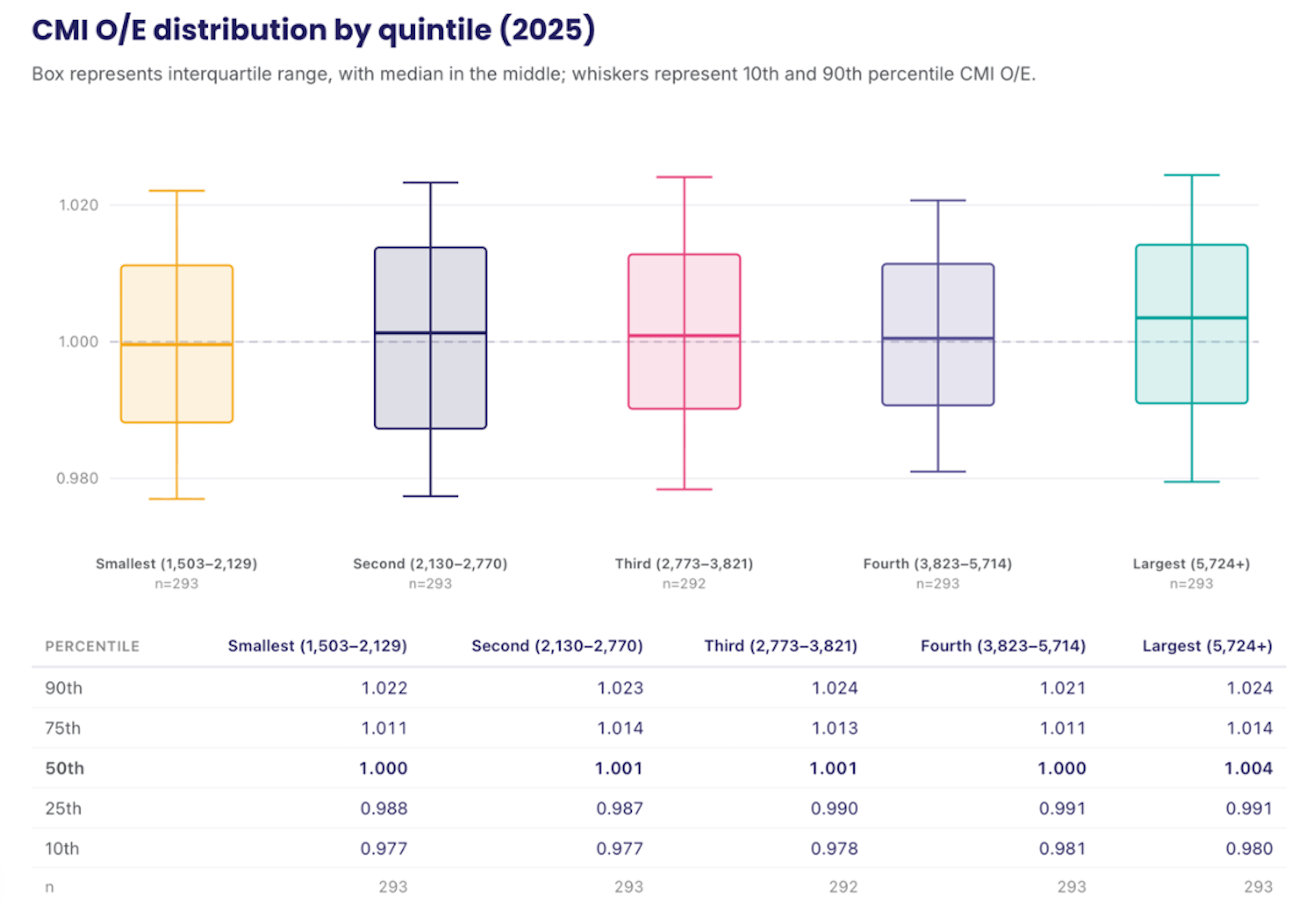
The graphic below shows the distribution of CMI O/E within five buckets, from the smallest hospitals (minimum 1,500 Medicare discharges) to the largest. For each bucket, the top and bottom lines represent the 10th and 90th percentiles—those with the lowest and highest CMI averages relative to expected. The box represents the 25th percentile (bottom), median (middle line), and 75th percentile (top) CMI O/Es within that hospital cohort.
The median large hospital, at right, has a higher CMI O/E than the hospitals in any other size quartile. But the top end—where we would expect to see the evidence if the best large hospitals are employing revolutionary tools—is no better for large hospitals than small ones. In fact, at any hospital size, the top 10% of hospitals achieve about the same CMI relative to expected.
If the top larger hospitals show no evidence of superior performance relative to smaller hospitals, maybe the signal will reveal itself over time?
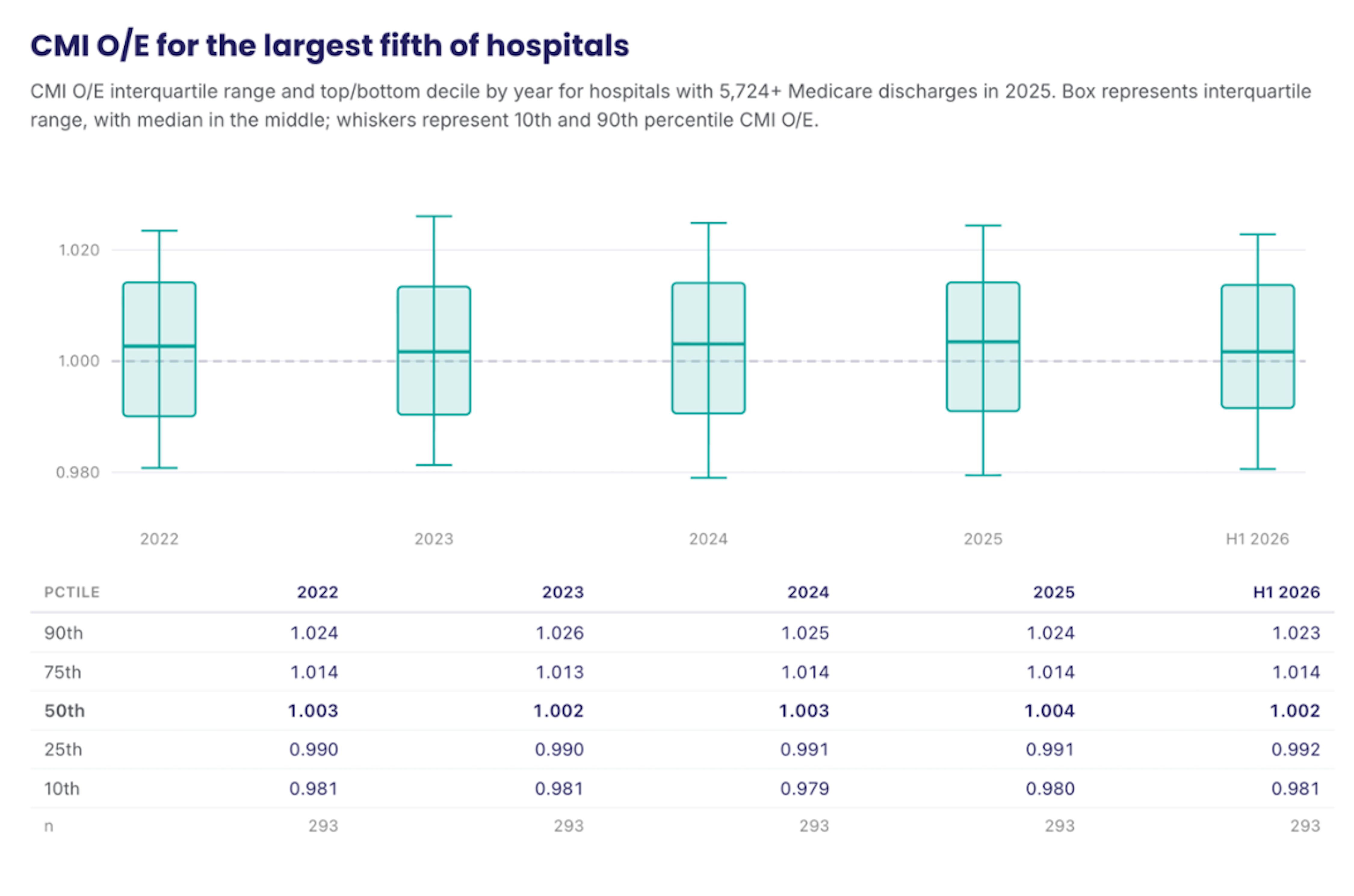
Again, not that we can see. The median hospital within our largest cohort by discharges is the same as it has been for the past five years, with no measurable shift even through the first half of 2026. And that remains true at the top end; the 10% of large hospitals with the highest CMI O/E in 2026 are no better relative to their peers than the top 10% in any previous year we looked at.
At HDAI we are incredibly bullish about AI’s potential, when thoughtfully developed and deployed, to improve so much of care delivery and hospital operations, including revenue integrity. In fact, we see in our own work how our diagnostic discovery tools are finding opportunities to capture and manage conditions that would otherwise go undiagnosed.
But this data is a reminder of just how early we are. If you’re an executive who feels like everybody else has moved much farther or faster, you should act with some urgency—but you haven’t been left behind just yet.
HDAI is working with several leading health systems on predictive diagnostic discovery to help hospital clinical, CDI, and coding teams identify diagnostic opportunities early and completely. If you’re interested in learning more, please contact Carola Endicott at carola.endicott@hda-institute.com.
Share this