
HCC and RAF: A scientific approach to finding your focus
By Maria Monahan, Sr. Data Analyst
Every ACO knows its risk-adjusted benchmark drives shared savings, but far fewer know exactly where they're leaving RAF on the table or which specific conditions are causing it. At HDAI, our team doesn't just look at an ACO's recapture rate, we benchmark it against its digital twin. A recapture rate on its own is just a number; benchmarking it against a twin built from similar patients nationally turns it into something more useful: a picture of where an ACO stands, how much room is left, and where that room concentrates.
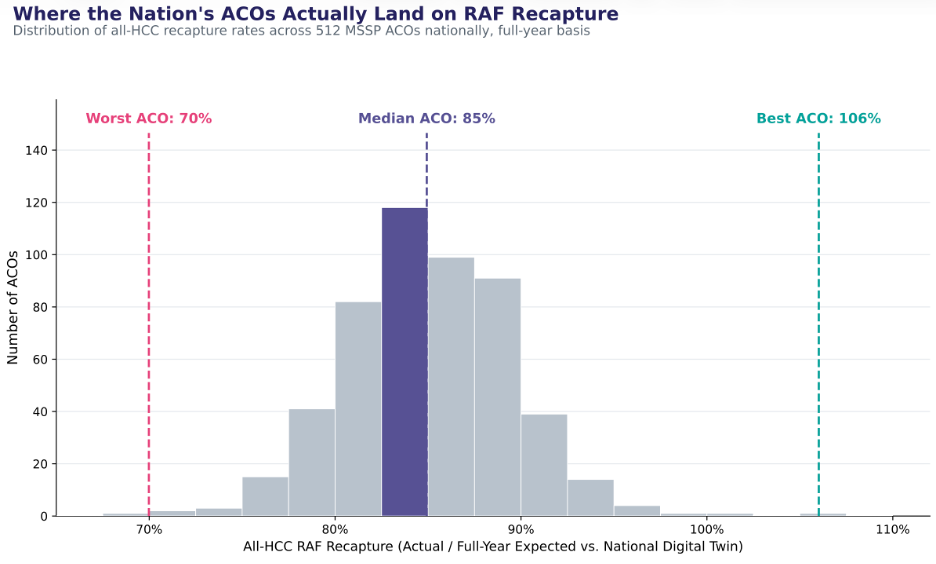
Comparing partial year (YTD 2026) capture to a full year expected target shows exactly how far along each ACO is toward where it needs to end up. On that basis, the typical ACO has captured 85% of its full-year expected RAF, the highest performing ACO has already reached 106% and the worst performing ACO is only at 70%.
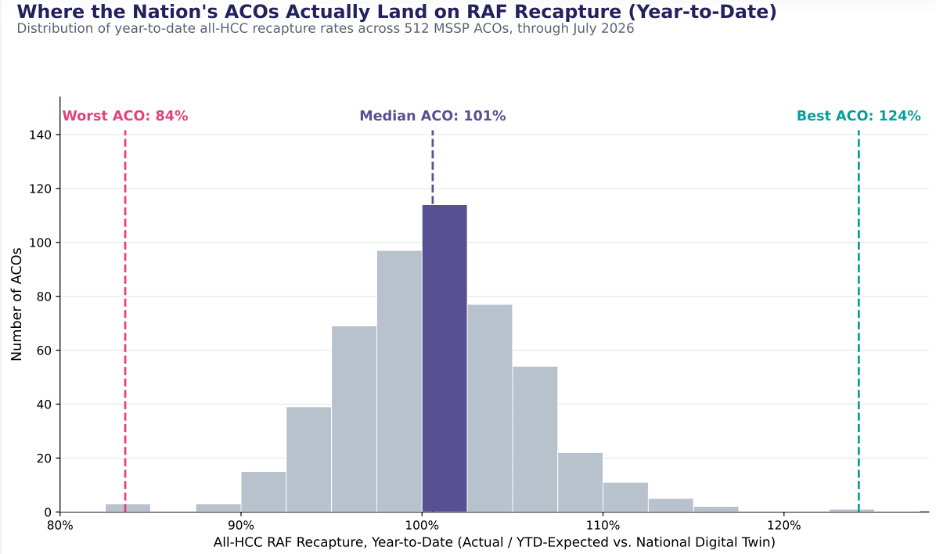
Measured against a year-to-date target instead — how each ACO is pacing relative to where it should be at this point in the year — the picture shifts noticeably: the typical ACO is essentially on pace to capture 1% more units than this time last year. The best performing ACO is running 24% ahead of expected by this point in the year, and the worst ACO has reached only 84% of potential capture, putting it 16% behind pace.
Where the opportunity concentrates
Across every ACO, heart failure accounts for more total missed RAF than any other single condition nationally — more than diabetes, any cancer category and COPD. About two-thirds of ACOs are underperforming on heart failure relative to their own digital twin. That’s because of a combination of complex condition, high prevalence, and variable management and coding practices.
One condition breaks from the pattern when you rank by how many ACOs fall short: major depression — common enough to matter, with RAF weight similar to diabetes. Sixty-eight percent of ACOs miss it, and they miss it by nearly the same margin, rather than spreading across a wide range of outcomes the way most conditions do. That kind of gap never looks unusual in any single ACO's numbers, which is exactly why it stays hidden without twin benchmarking – comparing each ACO to peers with the same HCC, capture history, and enrollment type, rather than one flat national number. That’s what gives an ACO something concrete to act on, rather than a vague sense that documentation can be better.
Diabetes tells the opposite story. It's common enough that any ACO can build a standing process around it, because the same condition shows up across many patients on every provider's panel. Confoundingly, of the roughly 186 HCCs, three in four affect fewer than half a percent of any given panel, and a meaningful share of those still carry real RAF weight. A single provider might have one patient with multiple rare-but-valuable conditions, no two alike, which means there's no single condition common enough to build a standing process around, the way diabetes allows. This is where the value of comparing every patient to their own twin really shows up. It doesn't matter whether a gap belongs to a common condition or a rare one — the same check runs either way, patient by patient, HCC by HCC.
Why the type of gap matters as much as the size
Once you know where a gap concentrates, the next useful split is between new HCCs and recapture-only HCCs, because the two point to different fixes. Both still require a clinical encounter (a condition can't be coded without one), but the visit itself looks different. A recapture gap means a condition is already on record, so the work is making sure it gets addressed and re-documented at a visit that's often already scheduled, like an annual wellness visit, with the right chart prep going in.
A new-HCC gap means the condition hasn't been identified yet, which can require additional workup or a visit scheduled specifically to evaluate it, before it can be documented at all. Treating both as one undifferentiated RAF opportunity number risks pointing the wrong resource at the problem.
What this looks like for one ACO
Applied to a single, anonymized ACO, these national patterns show up directly, though not always in the way the national numbers alone would predict.
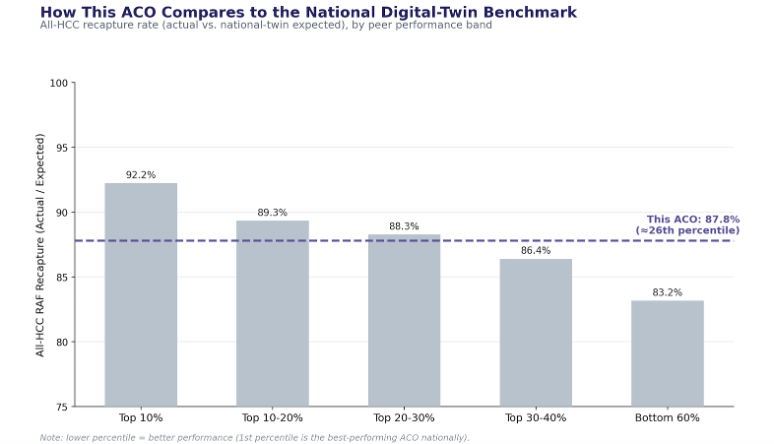
How an ACO compares to the national digital-twin benchmark
About a third of its patients carry a large individual gap, a slightly higher share than the national norm, which is where its overall standing comes from.
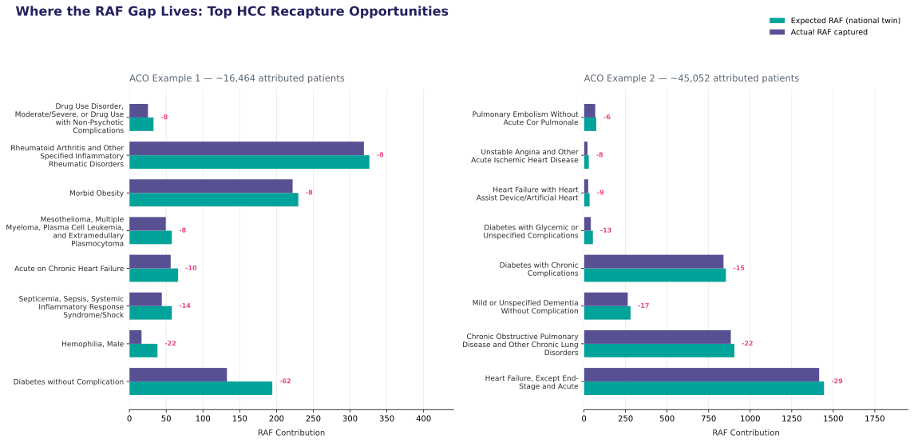
The condition driving the largest single piece of the gap for ACO Example 1 is diabetes without complication — not heart failure or depression, the two conditions that top the national list. ACO Example 2 tells a different story: its biggest gaps are heart failure and COPD, which actually do match the national pattern. Put side by side, the two examples make the same point twice, in opposite directions: one ACO's specific opportunity lines up with the national trend, the other's doesn't, and there's no way to know which case you're looking at without checking. That's the practical case for benchmarking against a digital twin built from an ACO's own patient mix rather than a national rule of thumb: it tells you what's actually true for your panel.
Why this traces back to shared savings
Getting RAF capture accurate is about making sure the benchmark reflects the reality of caring for a complex, often vulnerable patient population and funds the work of ACOs delivering better care to their patients.
We built HealthVision to run this comparison automatically, matching every patient to a twin built from the national Medicare population, so an ACO can see both its own biggest levers and how it compares to what the rest of the country is missing.
HCC recapture challenges are common but fixable, at least with the right data. If you're interested in learning where your ACO's HCC capture gaps are this year — while there's still time to close them — please contact us or email info@hda-institute.com for a free assessment.
Share this