
Looking Back on HLTH 2026: Sessions, Signal Reports, and Conversations on Trusted AI
By Carola Endicott, VP Customer Engagement and Marketing
Overview Summary
AI took center stage at HLTH 2026. HDAI joined partners from Houston Methodist and AWS to share how health systems can turn AI capabilities into measurable improvements in patient outcomes and met with leaders to review their own performance data.
From November 15 to 18, HLTH 2026 brought thousands of healthcare leaders to Las Vegas. At the center of it all was AI, with a dedicated AI Zone and sessions on care delivery, diagnostics, clinical decision support, and beyond.
For HDAI, the conference was a chance to share how we’re putting AI to work for hospitals and health systems. From showcasing our work with partners like Houston Methodist and AWS, to walking leaders through their organization’s performance data, here’s a closer look at the week.
Building AI Clinicians Can Trust: AWS, HDAI, and Houston Methodist
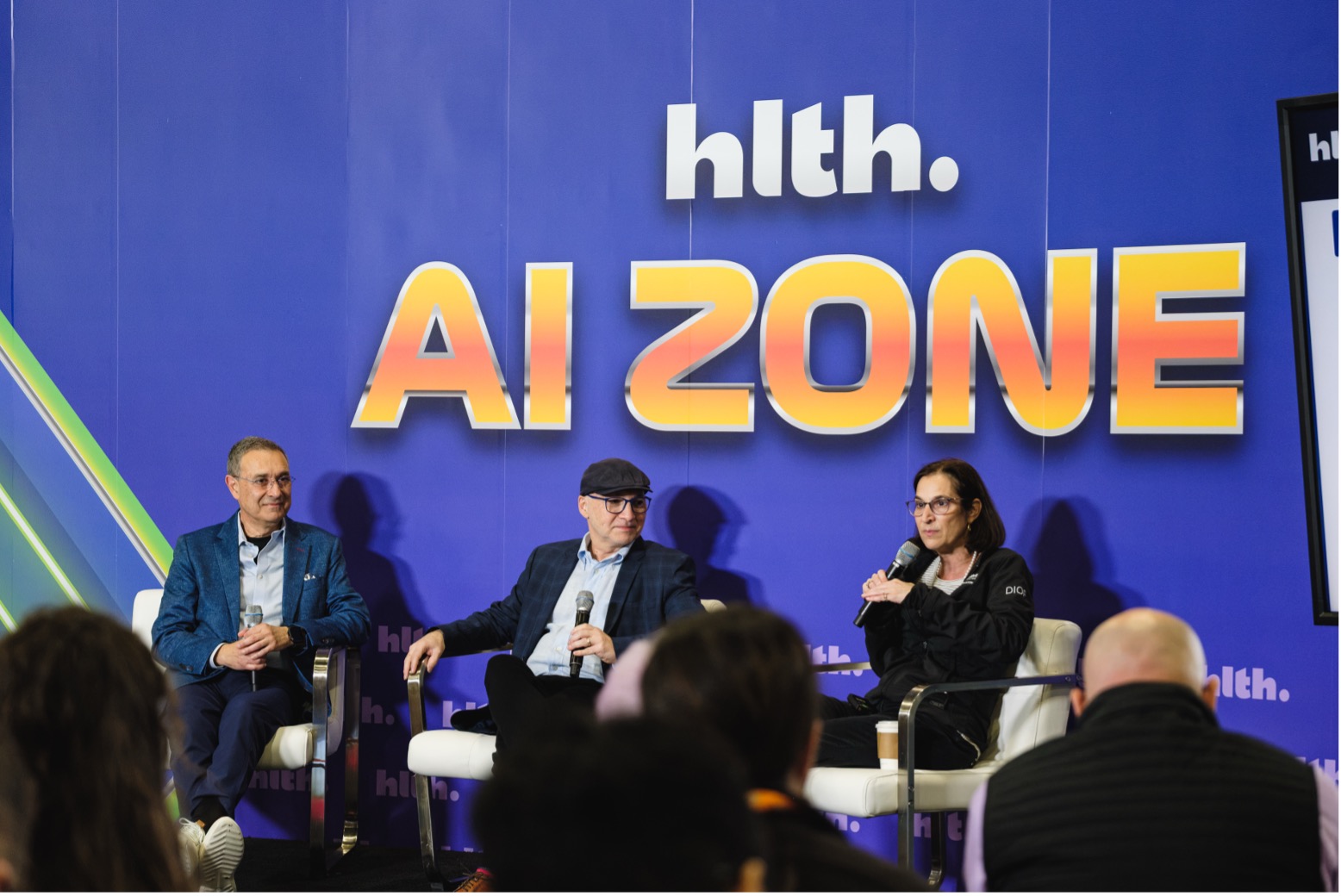
From left: Nassib Chamoun, Gerardo Castaneda, and Roberta Schwartz on stage in the HLTH AI Zone.
On Monday, Nassib Chamoun, Founder and CEO of HDAI, was joined on the AI Theater stage by Roberta Schwartz, Executive Vice President and Chief Innovation Officer at Houston Methodist, and Gerardo Castaneda, District Leader of Solutions Architecture at AWS, for a session titled “How Deep Reasoning AI Is Being Used Today to Improve Quality, Revenue, and Reputation.”
Health systems now have access to powerful frontier models, but putting them to work in patient care requires a reliable, transparent system and technology partners who keep those models within defined limits. Deep reasoning AI is built to that standard. It runs a patient’s complete, live record through high-accuracy, rule-bound language models and produces output clinicians can rely on.
Gerardo and Nassib walked through the governance layer, a combination of human oversight and technical controls that keep model output within bounds. AWS has helped us harden it further for academic medical centers that hold their AI partners to high standards. At Houston Methodist, teams use the system at the point of care to improve mortality, readmissions, quality, and revenue results without leaving their existing workflows.
Roberta said HDAI shows her team “very clearly where we need to focus our resources, where we really have very clear quality issues in advance of any other indicators showing them to us.” She also noted how far the models have come, speaking to Nassib: “I appreciate the fact that you retrained your models. Your models are spectacular now.”
When we started, very few institutions were willing to do what Houston Methodist did: invest in quality and outcomes up front. Over time, connecting those dots resulted in improved outcomes while helping Houston Methodist move towards funding quality with improved diagnostic capture before, during, and after hospitalization.
Reducing 30-Day Mortality and Readmissions at Houston Methodist
On Tuesday, I was thrilled to present alongside Brenda Campbell, Senior Innovation Consultant at Houston Methodist, who leads the rollout of clinical AI across all eight Houston Methodist hospitals. Our session, “How Predictive and Generative AI Helped Reduce 30-Day Mortality and Readmissions at Houston Methodist,” traced how that work took shape and the results that followed.
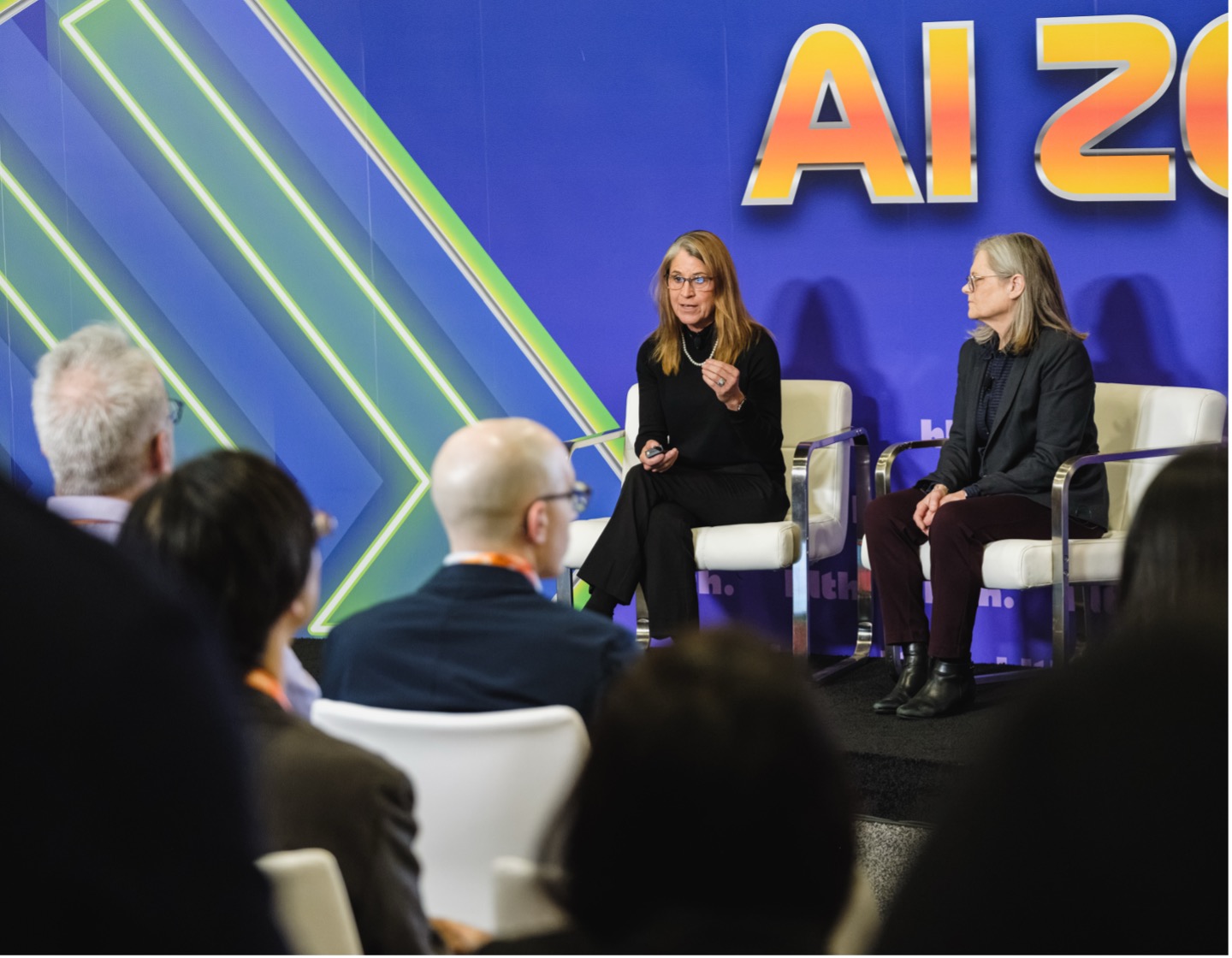
Houston Methodist’s Brenda Campbell and HDAI’s Carola Endicott on stage in the HLTH AI Zone.
Brenda and I discussed how predictive insights can help care teams direct follow-up resources to the patients most likely to benefit. Brenda shared four guiding principles: keep it simple, prioritize the highest-opportunity areas, keep clinicians involved, and embed the work in existing workflows.
For the surgical patient population discussed in the session, Houston Methodist Hospital’s national readmissions rank improved from 59th among 114 academic medical centers in 2022 to 7th in 2024, with stable patient acuity and no additional staff. Those results offered a concrete example of what focused implementation can achieve.
Brenda and Nassib discussed how Houston Methodist built this program, and what other health systems can learn from it, in an episode of “Healthcare AI Pioneers” earlier this year.
Conversations at Booth #4857
Between sessions, our team spent the week with health system leaders at Booth #4857 in the AI Zone. Many of those conversations began with the Performance Signal Report.
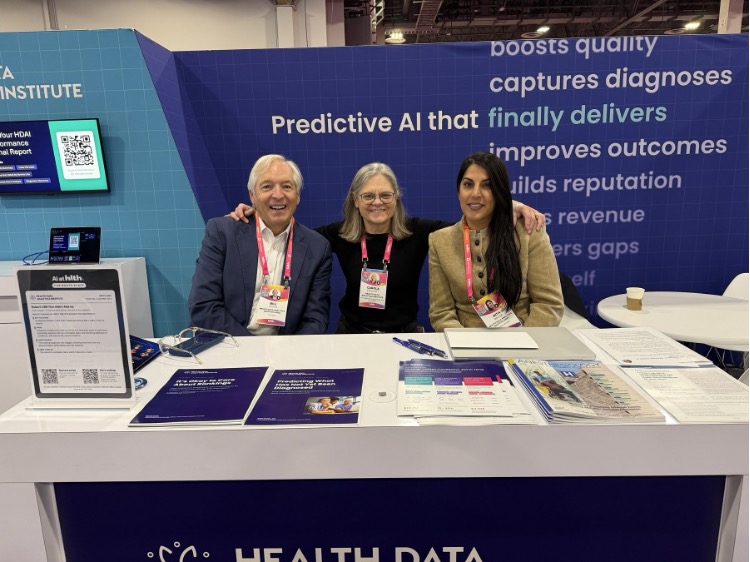
HDAI’s Bill Floyd, Carola Endicott, and Nita Bruce at the HDAI booth.
The Performance Signal Report is a personalized view of a hospital or health system’s performance, built from data the organization already has, so nothing needs to be sent to HDAI. Using the same data as national ranking organizations, HDAI benchmarks observed-to-expected mortality, readmissions, length of stay, and case mix index from 2023 to 2026 against peers and top performers. Each report includes:
A quality summary covering mortality, 30-day mortality, length of stay, hospice admissions, unplanned readmissions, and adverse events, compared with state averages and top-decile performers
Quarterly case mix index trends, compared with the national top 1,000 hospitals and the top 5% of peers
Thirty-day rates for adverse events, including acute kidney injury, falls, infection, cardiac events, and sepsis
A diagnostic discovery view that ranks the complications and comorbidities with the greatest revenue and mortality impact and identifies those likely to be missed
Visitors reserved 20-minute reviews to walk through their results with a member of our team, and each received an electronic copy of their report afterward.
Continuing the Conversation
Podcast: Beyond AI Hype: How Predictive Analytics Can Improve Patient Outcomes
For the AI at HLTH series on “The Beat,” Nassib sat down with host Sandy Vance to talk about how predictive analytics can help care teams prioritize the patients most likely to benefit. The main point: AI shouldn’t just give clinicians more information; it should help them find the right information, for the right patient, at the right moment. Listen to the full episode
White Paper: It’s Okay to Care About Rankings
For HLTH’s AI Zone, my colleague David Clain, HDAI’s Chief Product and Strategy Officer, wrote a white paper on how diagnostic capture relates to hospital quality rankings. Some hospital leaders worry that improving diagnostic capture is a coding exercise with no clinical benefit. National Medicare data suggest otherwise.
Using a digital twin analysis, the paper shows that hospitals in the top 20% for diagnostic capture have mortality about 20% lower than their risk-matched twins, and that most of that gap (63%) reflects lower observed mortality. Read the full white paper.
Looking Ahead to 2027
Every conversation we had this week reminded us that health systems are still figuring out how (not if) AI fits into workflows and into their existing tech stacks. We are grateful to Roberta Schwartz, Brenda Campbell, and Gerardo Castaneda for sharing their wisdom with the HLTH audience, and to everyone who stopped by our booth to see their data and discuss innovative solutions to the tough challenges ahead.
If you missed us at HLTH, request a demo to see what your own data shows.
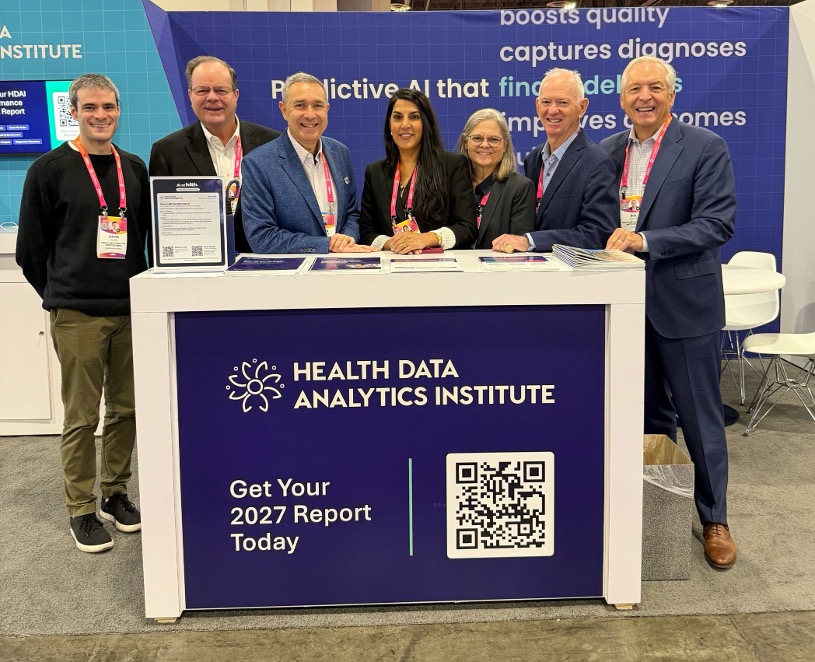
The HDAI team at their booth during HLTH 2026.
Share this