
Not just any AI: Deep reasoning for CDI and Coding
By David Clain, Chief Product and Strategy Officer, HDAI
Coders and clinical documentation improvement (CDI) specialists have a challenging but critical job: to identify, for reimbursement and quality measures, exactly what clinical conditions influenced a patient’s inpatient stay. A growing number of “AI” tools are aiming to support them in that work. But from what we see, many of these tools replicate straightforward logical rules without augmenting the thoughtful decision-making (deep reasoning) that CDI and coding work requires.
Simple, rules-based approaches are insufficient
Most pre- and early-AI technologies for diagnostic discovery are fundamentally rules-based: they define objective findings (like lab values) and subjective assessments (using simple natural language processing rules) that are associated with specific diagnoses. This approach is appealing in its simplicity, and before advanced AI it was the best we had: See low hemoglobin and the word “anemia,” use ICD-10 code D50.
But healthcare isn’t simple, and a CDI review is not that easy to replicate. Does that single lab value really represent clinically significant anemia? Is the diagnosis confirmed by a physician? Is there later evidence in the clinical record contradicting it? If the patient does have anemia, is it being treated or monitored sufficiently to code it? And more importantly, can we flag possible anemia early enough to improve the patient’s course of treatment?
We can automate the easy part of the coding and CDI jobs, but we should aim to do more than pluck the low-hanging fruit. We should assemble all the information these team members need to make their clinical determinations and query physiciansand, by extension, enable greater revenue and quality recognition from payers and ranking agencies.
HealthVision employs deep reasoning to support complex decision-making
With Predictive Diagnostic Discovery in HDAI’s next-generation AI solution, HealthVision, we use deep reasoning with advanced AI — combined with our own predictive models and clinical intelligence — to provide a full picture of each possible condition. Here’s what HealthVisionT displays for a patient with possible anemia:
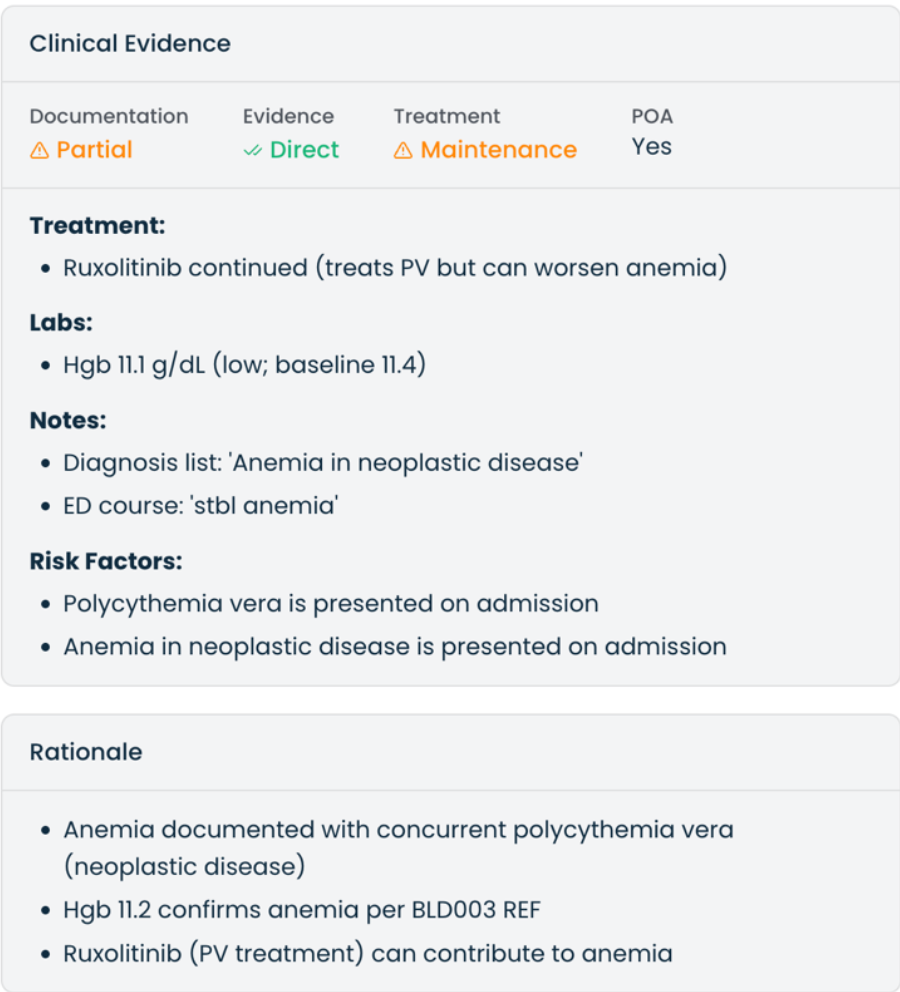
The context here is essential: not just the possible diagnosis and the words that trigger it, but a full assessment of the treatment and its possible effect, labs in the context of the patient’s own baseline, relevant excerpts from notes (linked in HealthVision to their source), and a rationale to support CDI and coding teams evaluating these findings. And, importantly, we balance completeness of information with an understanding of our users’ time constraints. It’s just as critical to know what is extraneous as it is to pull in the relevant data points.
To reliably generate this kind of information requires thoughtful and methodical use of AI. We’ll talk more in future weeks and months about our approach. Broadly, it requires four key ingredients that we think are in short supply:
Clear, detailed, and customizable clinical guidelines. LLMs are trained on, effectively, all documented human knowledge — but reliable adherence to coding and clinical rules requires explicit guidelines designed around an LLM’s specific strengths and limitations.
Sophisticated tools for automated testing and validation. Getting the best performance out of LLMs requires significant iteration — and then a way to know which iterations work.
Robust, often deterministic, and real-time verification. For all their strengths, LLMs make mistakes. Having simpler (often non-deterministic) checks of LLM outputs in a real-time production system can limit the mistakes that end users are exposed to.
Ongoing expert, human review. We lean heavily on AI, but we don’t outsource all our thinking to even the most advanced models. Our clinical team — in partnership with hospital coders and CDI specialists seeing real patient cases — routinely monitors the quality of output so we can improve it through model changes, prompt updates, real-time user feedback, and verification rules.
Next week, I’ll write more about how we integrate deep learning into an EHR-embedded workflow for CDI specialists and coders. My colleague Stewart Richardson, our VP for data science and engineering, will then share more about our real-time verification engine. Summer Kramer, PharmD, our VP for clinical programs, will talk about how we embed verifiable clinical intelligence into our deep reasoning framework.
If you’re interested in learning more about our work — or about how you can partner with HDAI to deploy Predictive Diagnostic Discovery at your health system — please contact info@hda-institute.com.
Share this